
Export to Russia logistics starts with one question: where will the cargo sit longest? The truck queue at Astara, the feeder delay at Anzali, or the Russian customs hold over a missing paper. In 2026, the INSTC is moving more freight than ever, but the Rasht–Astara rail link is still not open. That missing piece changes the math on every route.
Apadana moves reefer produce, bagged cement, polymer pellets, and project equipment along this corridor. Below, the three routes from an execution standpoint, and which cargo fits each one.
The Three INSTC Routes: What Each One Is Good For
This corridor is not one road or rail line. It is a set of routings you combine based on urgency, volume, and border risk tolerance.
Western Route via Azerbaijan
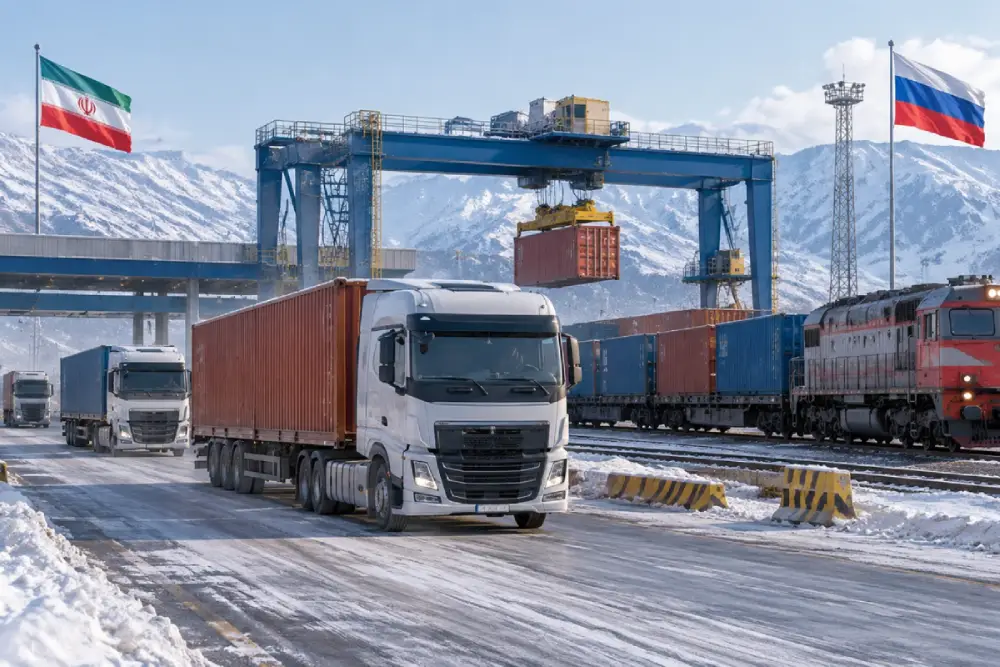
The Western Route via Azerbaijan is the first choice for time-sensitive road freight. Cargo goes from northern Iran through Astara into Azerbaijan and on to Russia. Simplicity is the appeal: one truck, one CMR, direct delivery. Astara is the bottleneck—truck queues and transloading delays are routine in peak season. Since the Rasht–Astara railway is not running, rail cannot yet bypass this segment. For LTL and urgent FTL, it is still the most direct option.
Caspian Sea Route
Starting at Anzali or Amirabad, the Caspian Sea Route reaches Russian ports such as Astrakhan or Makhachkala and connects to Russian rail. Its value is bypassing land border congestion. Container services on this axis have logged around 25 days from Russian origin to Iranian ports in recent trials. On the Iranian shore, however, no direct rail exists between Anzali and Bandar Abbas, so containers need a road or rail leg. When equipment is short, the transfer stalls. This route suits FCL cargo where a few days of variability is acceptable.
Eastern Route via Turkmenistan and Kazakhstan
Spreading risk is what the Eastern Route does best. It avoids Azerbaijan entirely and reduces exposure to that border’s political and operational swings. The distance is longer, but border pressure is distributed differently. If you don’t want all your eggs in one border basket, the eastern branch is a fallback or a scheduled alternative when the western border deteriorates. Many exporters, as a result, keep it in rotation rather than treating it as a last resort.
Apadana’s cargo management team repeats one rule: keep live quotes for at least two routes. The “best” route shifts with border queues, Caspian vessel schedules, and Russian customs workload. A single-route plan breaks at the first border problem.
Western Road Corridor: CMR Documentation and the Astara Reality
The western road route works under the Iran–Russia road transport agreement. A 1994 bilateral framework lets carriers from either country move import and export cargo between the two states without a special permit. Transit and third-country movements require permits.
The CMR Waybill: Where Discrepancies Get Caught
The CMR waybill is the central document. Consignee details, goods description, package count, and gross weight must match the commercial invoice exactly. Russian customs officers are strict about discrepancies. Even a translation variant in the product description can hold cargo at the border. A workable practice is to include the Russian-language description the importer has confirmed, not just English or Persian. Reconcile the CMR against the invoice line by line before dispatch.
Transloading at Astara: Time Budget and Vehicle Checks
At Astara, transloading speed drives total transit time. If cargo must move from an Iranian truck to an Azerbaijani or Russian vehicle, one to two days for the swap and formalities is realistic. For overland transport, Apadana’s coordinators confirm vehicle availability on the Azerbaijani side before departure. Cargo then does not arrive to wait for a receiving vehicle. The team also tracks queue conditions daily in peak season.
One detail that catches people out: overweight and oversize vehicles, as well as dangerous goods, require special authorization. For heavy machinery or chemical cargo, secure that permit before dispatch—not at the frontier.
Caspian Multimodal: Port Handoffs and Container Management
The Caspian route’s difficulty is not the sea leg. It is the port interface. Once cargo lands at Anzali, it needs a rail wagon or truck to move onward. In peak periods, container handling capacity at the northern port becomes the constraint.
Container Leasing and Free-Time Planning
Container leasing strategy matters more here than the ocean freight rate. If the exporter owns the boxes, the repositioning cost from the northern port to southern Iran must be priced into the landed cost. When carrier containers are used, confirm the free time covers the inland Iranian leg. Some operators keep depots at Tehran, Bandar Abbas, and Anzali and offer long-term leases, which reduces detention risk when empty return slips. For bulk liquid transport and temperature-sensitive cargo, verify vessel capability in advance; not every Caspian feeder has reefer plugs. Moreover, confirm reefer capacity in writing, not from the vessel type.
Which Cargo Fits This Route
This route fits cement, fertilizer, polymer resin, and non-urgent industrial inputs. Apadana’s sea freight desk structures it as a door-to-door product: road collection in Iran, Caspian feeder, rail delivery in Russia. The quotation is door-to-door, but the client should know at least two handoffs are embedded and the transit band is wider than pure road. That wider band is the trade-off for avoiding land border volatility.
Rail and Rail–Road Combinations Before Rasht–Astara Opens
The Rasht–Astara railway would allow seamless rail from the Iranian network into Azerbaijan and Russia. As of 2026, land acquisition is complete and construction is moving forward with Russian participation. The line is not yet operational.
The Interim Rail–Road Model
A rail–road combination serves as the interim solution: truck cargo from anywhere in Iran to the Astara rail station, load onto rail wagons inside the customs-controlled yard, and dispatch by rail through Azerbaijan to Russian hubs—Moscow, Kazan, St. Petersburg, and beyond. The economics favor this for heavy and long-haul cargo: one rail wagon carries roughly 60 tonnes, equivalent to three truckloads, at a lower unit cost. Schedule the road drayage tightly to avoid missing the wagon departure.
Wagon Availability and Project Cargo
For rail transportation, wagon availability is the scheduling constraint. Azerbaijani rail wagon supply is not unlimited, especially during agricultural export peaks. Confirm the dispatch date and wagon type—boxcar, flatbed, or tank—with the rail agent in advance. Project cargo such as oversized equipment also needs an approved loading and securing plan that meets Russian railway technical conditions. Book project cargo earlier than standard freight, because approvals take longer than wagon allocation.
From a complete logistics performance management perspective, the KPI for rail–road is total cost per tonne from factory gate to Russian consignee warehouse, not transit days alone. Above a certain volume, the rail segment’s cost advantage survives the extra road drayage.
Customs and Documentation: What Actually Gets Checked at the Russian Border
Russian customs scrutiny under the Eurasian Economic Union framework has tightened. The most common failure mode for Iranian exporters is incomplete or inconsistent documentation. Cargo then sits in a customs control zone while storage and detention charges pile up.
The Core Document Set
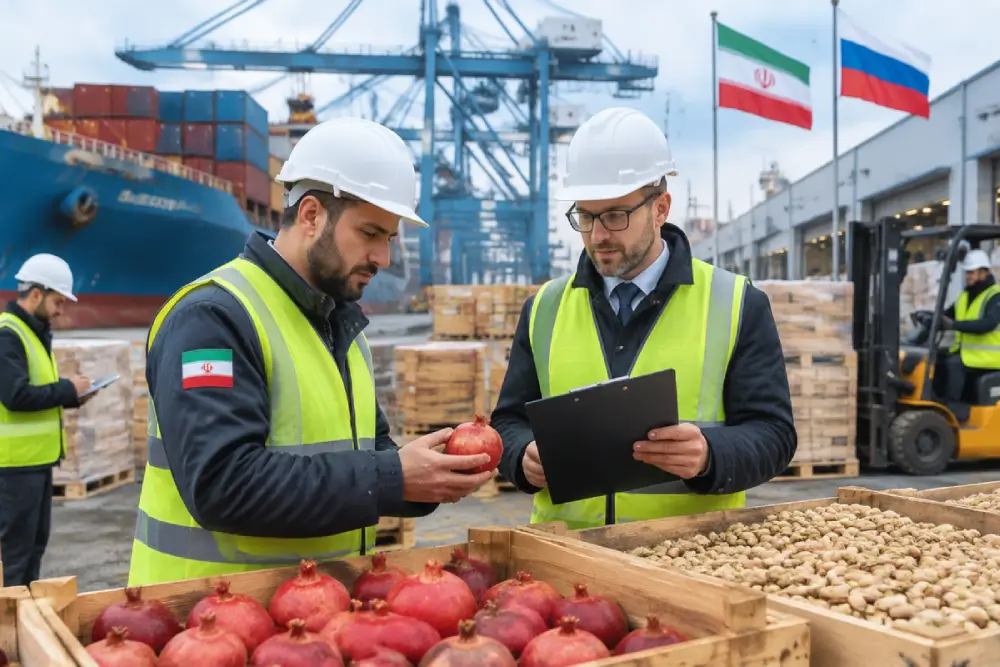
The core document set is: commercial invoice with complete Russian importer details, HS codes matching the goods description, certificate of origin, packing list, CMR or rail waybill, and product-specific certificates—sanitary, veterinary, or EAC conformity declaration. Agricultural products such as pistachios, kiwi, and shrimp need certificates recognized by Russia’s Federal Service for Veterinary and Phytosanitary Surveillance. Industrial goods including cement and polymers may fall under mandatory certification lists. Build the checklist per product category, not from a previous shipment.
Invoice Value: The Under-Invoicing Trap
A practical warning: Russian customs examines invoice values more closely than Iranian export declarations do. Under-invoicing may clear on the Iranian side. If it gets flagged in Russia, however, the penalty and revaluation process takes far more time than the duty saved. Keep invoice value consistent with the contract and payment record. For first-time exporters, consultancy is less about form-filling and more about knowing which certificates need months of lead time. Compliance planning belongs at the quotation stage, not at the border.
Budgeting Clearance Time
Customs clearance time budgeting: with complete documents and no inspection, clearance at major Russian entry points can complete in three to five working days. If inspection or document correction is triggered, a week or more is common. Build that range into the delivery commitment to the Russian buyer rather than explaining the delay afterward. Tell the buyer which document gaps push a shipment into the longer band.
Matching Cargo to Route: A Decision Table
| Cargo type | Recommended route | Key consideration |
|---|---|---|
| Greenhouse peppers, kiwi, shrimp (reefer) | Western road (reefer truck) | Time-critical; budget Astara transloading; confirm Russian sanitary certificates |
| Cement, polymers, fertilizer (bulk) | Caspian multimodal or rail–road | Cost-sensitive; lock rail wagon plan early |
| Pistachios, dates (dry) | Western road or Caspian FCL | Moisture protection; phytosanitary certificate in customs pack |
| Industrial equipment, project cargo | Rail–road combination | Wagon type and securing plan pre-approved |
| Urgent spares, high-value small lots | Western road or air freight where available | Air freight suits very small high-value shipments |
Frequently Asked Questions
How fast can cargo move from Iran to Russia?
Western road: roughly 7–10 days from Tehran to Moscow when the Astara border is clear. Caspian multimodal: approximately 20–25 days. Rail–road combinations typically run 3–5 days slower than pure road due to wagon connection and transloading. Actual time depends on border queues and Russian clearance speed.
When will the Rasht–Astara railway open?
Not yet operational as of 2026. The project has moved into construction with Russian involvement, but no confirmed completion date has been announced. Until then, rail cannot run directly from Iran into Azerbaijan, and road drayage to the Astara rail station remains necessary.
What certificates does cement require for Russian import?
Cement typically requires certificate of origin, commercial invoice, packing list, and transport document. Russia may require an EAC conformity declaration or GOST certification depending on grade and application. The Russian importer should confirm the HS code and certification pathway before shipment, as construction materials requirements can vary by end-use.
Is container or breakbulk shipping more cost-effective on the Caspian?
It depends on volume and cargo type. FCL containers move on scheduled feeder services with fixed slot availability. Bulk cement or fertilizer can use breakbulk or specialized tank containers. Container equipment at Caspian ports can tighten in peak season; owned or long-leased boxes reduce dependence on carrier equipment. For a first Caspian shipment, sending one test container to validate port handling and customs handoff is more prudent than committing a large volume immediately.
Apadana provides end-to-end supply chain solutions across the INSTC, from inland Iran collection and border transloading coordination to final delivery at Russian destinations. The requirement may be overland transport, rail transportation, sea freight, or air freight for urgent shipments. Based on current border and port conditions, the team can structure a route that fits your cargo. When requesting logistics rates, giving cargo type, volume, origin, and Russian destination city gets you a more accurate proposal than a generic “how much to Moscow?” inquiry.