When a trailer is held at the Bazargan border crossing because the destination customs pre-clearance has not been matched to the CMR consignment note, every hour of delay compounds demurrage costs and disrupts downstream delivery windows. Cross-border trucking from Iran to Europe is no longer a straightforward modal choice; it is a supply chain decision that determines margin, contractual reliability, and access to European industrial buyers.
This guide examines the operational realities of overland transit, corridor selection, documentation, and risk mitigation from a freight forwarding perspective.
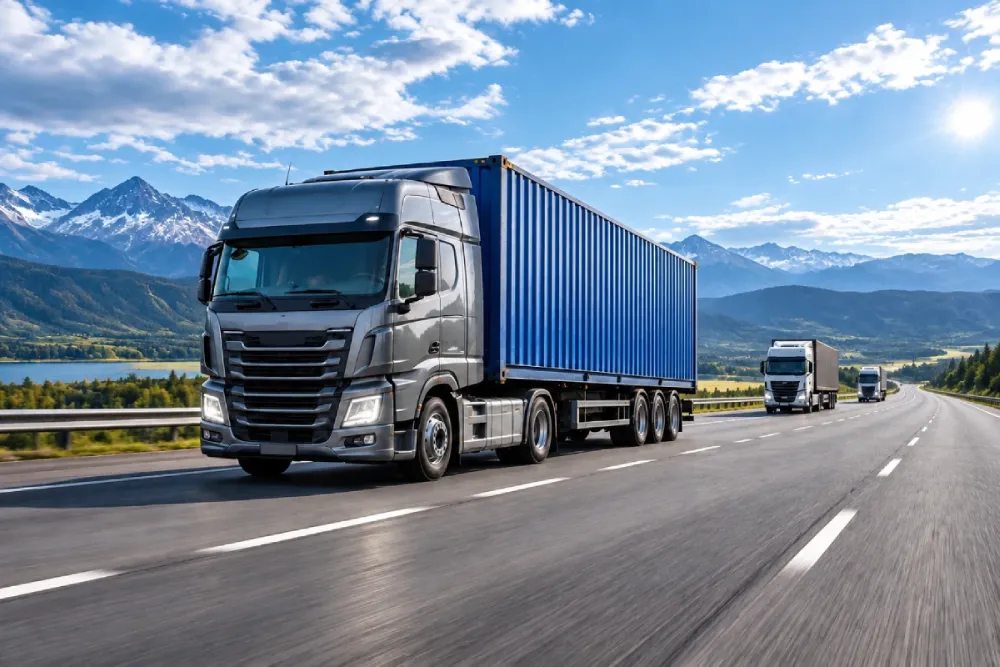
Why Cross-Border Trucking Remains the Backbone of Iran–Europe Overland Trade
Road freight offers three structural advantages that no other mode fully replicates:
True door-to-door service: No re-handling at ports or rail yards.
Origin flexibility: Direct loading from manufacturing sites in Tabriz, Arak, or Mashhad.
Relative transit predictability: On Balkan and Turkish routes, transit times can be estimated with reasonable accuracy.
These advantages become liabilities, however, when corridor selection, carrier qualification, or customs documentation are managed without operational discipline.
Primary Trucking Corridors from Iran to Europe
Turkey–Balkans Corridor (Classic and High-Volume)
This route starts at Bazargan or Sero, transits Turkey, and continues through Bulgaria, Serbia, Croatia, Slovenia, and into Austria or Germany. Its strength lies in robust road infrastructure and multiple logistics terminals. The downside: border congestion at Gürbulak and Kapıkule during peak seasons, plus secure parking costs in Bulgaria.
Caucasus–Black Sea Corridor (Road–Sea Multimodal)
From Astara to Baku, then Ro-Ro ferry from Baku or Poti to Romanian (Constanța) or Ukrainian (Odesa) ports, followed by trucking to Central Europe. This corridor is logical for cargo originating in northwestern Iran or for shipments requiring avoidance of Turkish transit constraints.
INSTC Northern Branch (Europe Exit)
Although designed primarily for Russia and India trade, branches via Russia and Belarus into Poland and Germany are feasible. For project cargo and specific commodity flows, this can be a lower-cost alternative.
To select the optimal corridor based on cargo type and final destination, Apadana Freight Logistics can provide an initial assessment within 24 hours through its TRANSIT SERVICE desk.
Modal Comparison for Iran–Europe Transit
| Mode | Estimated Transit Time | Relative Cost | Best Suited For | Primary Risk |
|---|---|---|---|---|
| Road (Turkey – Balkans) | 7–14 days | Medium | FTL, industrial cargo, time-sensitive goods | Border delays, demurrage |
| Road–Sea (Caucasus – Black Sea) | 14–25 days | Medium–High | Heavy cargo, project shipments | Vessel schedule mismatch |
| Rail (via Sarakhs or Astara) | 18–30 days | Lower | Bulk cargo, full containers | Gauge changes, yard delays |
| Sea (Bandar Abbas – Europe) | 30–45 days | Low | LCL, non-urgent cargo |
Key Customs Documentation for Cross-Border Trucking
Without precise documentation, even the best corridor stalls. Minimum checklist:
CMR Consignment Note: The primary road transport contract defining liability.
TIR Carnet: Enables multi-border transit without re-inspection at each customs post.
Certificate of Origin: Required for preferential tariff treatment in the EU.
Transport Permits: For truck operation in transit countries, particularly Turkey and the EU.
CMR Insurance: Covers risk en route and at intermediate warehouses.
For complete documentation management and customs clearance at origin and destination, engage Apadana’s specialized CONSULTANCY team.
Operational Challenges and Risk Mitigation
1. Border Terminal Waiting Times
At Bazargan, truck queues during agricultural export season can reach 48 hours. Mitigation: book time slots and consider alternative crossings such as Sero or Razi.
2. Demurrage and Standstill Costs
Each day a trailer is held in Europe can generate €200–€500 in costs. A precise forwarder contract defining liability for customs delays is essential.
3. Cold Chain Management
For temperature-controlled cargo, BULK LIQUID TRANSPORT and reefer containers with temperature logging are mandatory. Any break in the cold chain can destroy the entire shipment.
4. Compliance with European Standards
Since 2024, enforcement of Euro 6 emission standards for trucks has intensified in Germany, Austria, and the Netherlands. Older trucks may be barred from certain urban zones.
The Forwarder’s Role in Successful Overland Transit
A professional forwarder does not merely quote rates. It:
Selects the optimal route based on cargo type, destination, and sanctions risk.
Executes COMPLETE LOGISTICS PERFORMANCE MANAGEMENT with GPS tracking throughout transit.
Deploys local teams to resolve unexpected stoppages.
Verifies customs documents before truck departure to prevent border holds.
Apadana Freight Logistics, through its partner network in Turkey, Bulgaria, Serbia, and Germany, delivers integrated OVERLAND TRANSPORT with full CMR coverage.
Execution Steps for Overland Transport to Europe (Operational Checklist)
Define appropriate Incoterms (typically DAP or DDP for Europe).
Request freight rate quotations from at least two qualified forwarders.
Prepare documents: CMR, TIR, Certificate of Origin, commercial invoice, packing list.
Clear customs at origin with a licensed broker.
Track the shipment throughout transit.
Clear customs at destination and deliver to consignee.
Final settlement and Proof of Delivery (POD) confirmation.
Frequently Asked Questions
How long does cross-border trucking from Iran to Europe take?
Depending on the corridor, 7 to 25 days. The Turkey–Balkans route is fastest; the Caucasus–Black Sea route requires more time due to vessel scheduling.
Is a TIR Carnet required for trucking to Europe?
For multi-border transit without re-inspection, a TIR Carnet is effectively mandatory. Without it, customs clearance must be repeated at each border.
What is the difference between CMR and TIR?
CMR is the road transport contract defining carrier liability; TIR is the customs transit document enabling border crossing without intermediate inspection.
What equipment is required for temperature-controlled cargo?
Reefer containers or ISO tanks with temperature logging, plus specialized cargo insurance for perishable goods.