
Supply chain managers and commercial procurement leads often face a tough balancing act: ocean logistics can tie up working capital for months, while traditional ground routes may encounter regional choke points. At the same time, booking air cargo without a clear cost-benefit rationale can burn through quarterly operating budgets.
Air freight is not a catch-all solution for every product line. It is a high-precision, tactical instrument designed for high-value merchandise, time-critical assembly lines, and perishable supply chains. Navigating air cargo efficiently requires a solid grasp of volumetric ratios, airline allotment bottlenecks, and seasonal surcharge mechanics.

Strategic Scenarios: When Does International Air Freight Make Sense?
Selecting air transport should always be a numbers-driven decision. The premium on freight rates must be offset by measurable savings elsewhere—such as avoiding warehouse carrying costs, production downtimes, or contract penalty clauses.
High Value-to-Weight Ratio Products
High-end consumer electronics, microchips, laboratory components, and precision machine parts benefit significantly from short exposure times. When inventory represents hundreds of thousands of dollars, every day spent in transit carries real financial risk. A specialized air freight company provides airport-to-airport chain of custody, controlled bonded warehouses, and minimal handling touches, sharply reducing the incidence of theft, breakage, and moisture exposure.
Perishables and Temperature-Controlled Cold Chains
Active pharmaceuticals, active biological ingredients, and fresh perishables operate on strict expiration timetables. When thermal variation compromises entire product batches, the speed of air routing is critical. Operating through dedicated temperature-controlled air freight containers (Envirotainers) with real-time telematics ensures the integrity of sensitive shipments across cross-continental lanes.
Plant-Shutdown Emergencies and Spare Parts
When an automotive manufacturing cell or automated sorting center stops due to a broken component, the cost of halted operations dwarfs the cost of flying a part internationally. Here, relying on international air freight serves as an operational insurance policy: getting replacement components delivered, cleared, and fitted on-site inside 48 to 72 hours.
Rapid Product Launches and Market Testing
Before committing to high-volume maritime contracts, businesses often test new consumer products or seasonal apparel lines in local markets. Shipping initial batches by air allows commercial teams to capitalize on short-lived market trends and gather customer feedback without building inventory debt.
Technical Factors Shaping Air Freight Costs
Freight invoices rarely consist of a single flat rate. Commercial shippers need to account for multi-variable pricing structures to avoid post-shipment invoice discrepancies.
The Mechanics of Chargeable Weight
A frequent trap in air cargo is evaluating cost solely by physical gross weight. Aircraft payload capacity is restricted both by gross lift capability and hold volume. Under IATA standards, freight forwarders evaluate both metrics and bill according to the higher value.
Volumetric Weight (kg)=Length×Width×Height (cm)۶۰۰۰ \text{Volumetric Weight (kg)} = \frac{\text{Length} \times \text{Width} \times \text{Height (cm)}}{۶۰۰۰}
(Note: Certain door-to-door express couriers employ a 5000 divisor.)
If a shipment consists of bulky lightweight materials—such as protective packaging, insulation, or assembled structures—the volumetric weight will exceed scale weight, dictating the chargeable baseline. Smart crating and volumetric optimization can cut baseline transport expenses considerably.
Dynamic Surcharges: Fuel, Security, and Seasonality
Airline pricing shifts based on external commodities and seasonal demand swings. Fuel Surcharge (FSC) tracks global aviation fuel spot prices, while Security Surcharges (SSC) cover automated screening, explosive trace detection, and airport security infrastructure. Peak shipping periods (such as Q4 retail pre-stocking) see tightening capacity on trunk routes, pushing market rates upward.
Terminal Handling and Ground Access Fees
Moving goods through a busy air cargo terminal involves Document (AWB) preparation, customs declaration, airline terminal handling charges (THC), and potential screening or storage fees. Partnering with an experienced international freight forwarder helps streamline these accessorials and avoid unexpected terminal demurrage charges.
What Really Drives Transit Times?
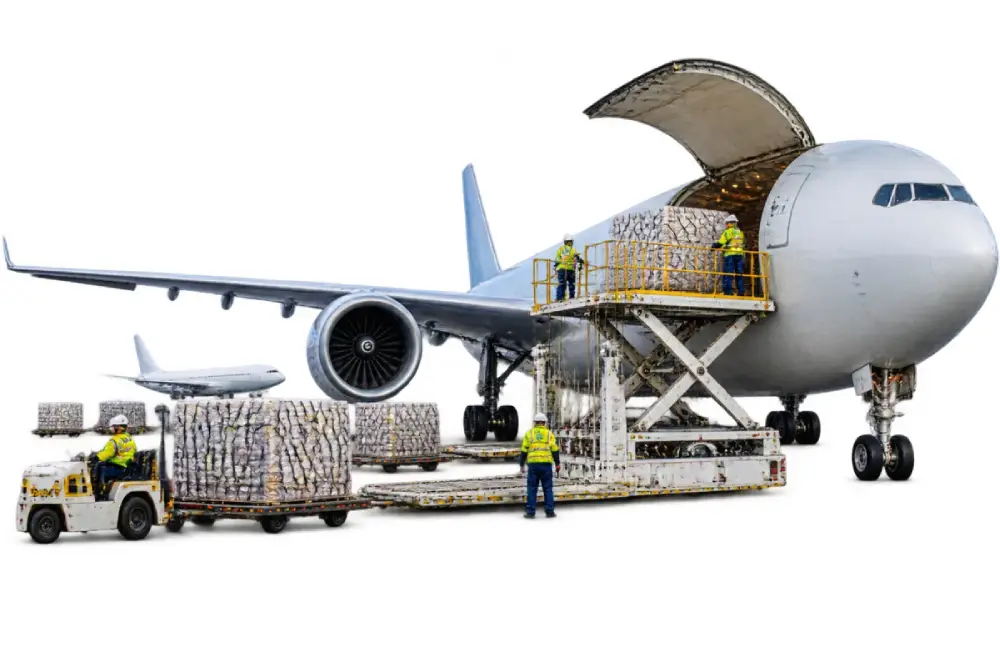
The actual flight time across continents is rarely longer than 10 to 14 hours. Yet average airport-to-airport transit times routinely fall within 3 to 6 days. Where does the extra time go?
Direct Flights vs. Transshipment Hubs
Direct cargo or belly-hold flights offer the quickest turnaround but are bound to scheduled origin-destination pairings. Multi-leg itineraries with hub stopovers (transshipments) lower freight costs by consolidating cargo, but introduce transshipment delay risks. If an inbound flight is delayed or an ongoing flight suffers an offload due to weight limits, pallets can sit on apron warehouses for additional shifts.
Airport Ground Handling and Security Screening
Goods must clear acceptance gates well before scheduled aircraft takeoff. Security protocols, including x-ray screening, sniffer checks, or 24-hour sniffer holds for uncertified shippers, require cargo to be tendered hours ahead of flight departure. Regulated cargo, such as lithium-ion battery assemblies, undergoes additional technical inspections against Material Safety Data Sheets (MSDS).
Customs Clearance and Document Harmonization
Clean documentation—commercial invoices, packing slips, ATR/EUR.1 certificates, and accurate HS code classification—is the linchpin of quick transit. Inconsistencies between physical crate markings and digital manifests flag shipments for secondary customs examination, negating the time savings gained in the air. Utilizing dependable transit services and localized brokerage ensures regulatory clearance proceeds without unnecessary border holds.
Hybrid Logistics: The Multi-Modal Alternative
Modern global trade does not demand an all-or-nothing choice between high-speed aviation and traditional ocean voyages. Combining freight modes can bridge the gap between cost efficiency and time sensitivity.
Apadana International Transport provides integrated multimodal solutions spanning air, road, rail, and sea freight. If purely flying an entire consignment is cost-prohibitive, Apadana’s operations desk can engineer hybrid solutions: shifting the long-haul leg via rail or sea, complemented by targeted air freight routing for the critical final miles. This keeps your inventory moving on tight schedules while preserving commercial profit margins.
Practical Pitfalls to Avoid in Air Cargo Operations
- Neglecting Dangerous Goods (DGR) Regulations: Aerosols, lithium cells, paints, and perfumes require certified UN packaging, specific label placement, and Dangerous Goods Declarations (DGD). Misdeclaration leads to immediate airline rejection and heavy carrier fines.
- Inadequate Packaging for Air Conditions: Packaging must withstand cabin air pressure shifts, turbulence, and rapid multi-tier palletizing. Weak external cartons collapse under cargo strapping.
- Unclear Incoterms Allocation: Ambiguity over whether the consignor or consignee absorbs destination airport handling charges (e.g., in FCA vs. CPT terms) frequently causes cargo to sit idle on the destination tarmac while parties resolve invoices.
FAQ
How is chargeable weight calculated in air shipping?
It is calculated by comparing actual gross weight against volumetric weight (Length × Width × Height in cm divided by 6000). The carrier bills whichever figure is greater.
What is the realistic delivery timeline for international air cargo?
Direct flights generally deliver within 2 to 4 working days (including standard customs and terminal handover), whereas multi-stop consolidated shipments usually take between 4 and 7 business days.
Can any cargo be flown on standard commercial freighters?
Most commercial products can fly, provided they adhere to size limits and IATA DGR rules. Highly hazardous materials, corrosive chemicals, and specific oversized machinery require dedicated chartered aircraft or alternative transport modes.
What is the difference between air cargo and courier express?
Courier express handles small parcels, documents, and samples under closed-loop networks with door-to-door delivery. Air cargo (air freight) manages larger palletized or crated industrial shipments moved airport-to-airport, requiring dedicated customs brokers.